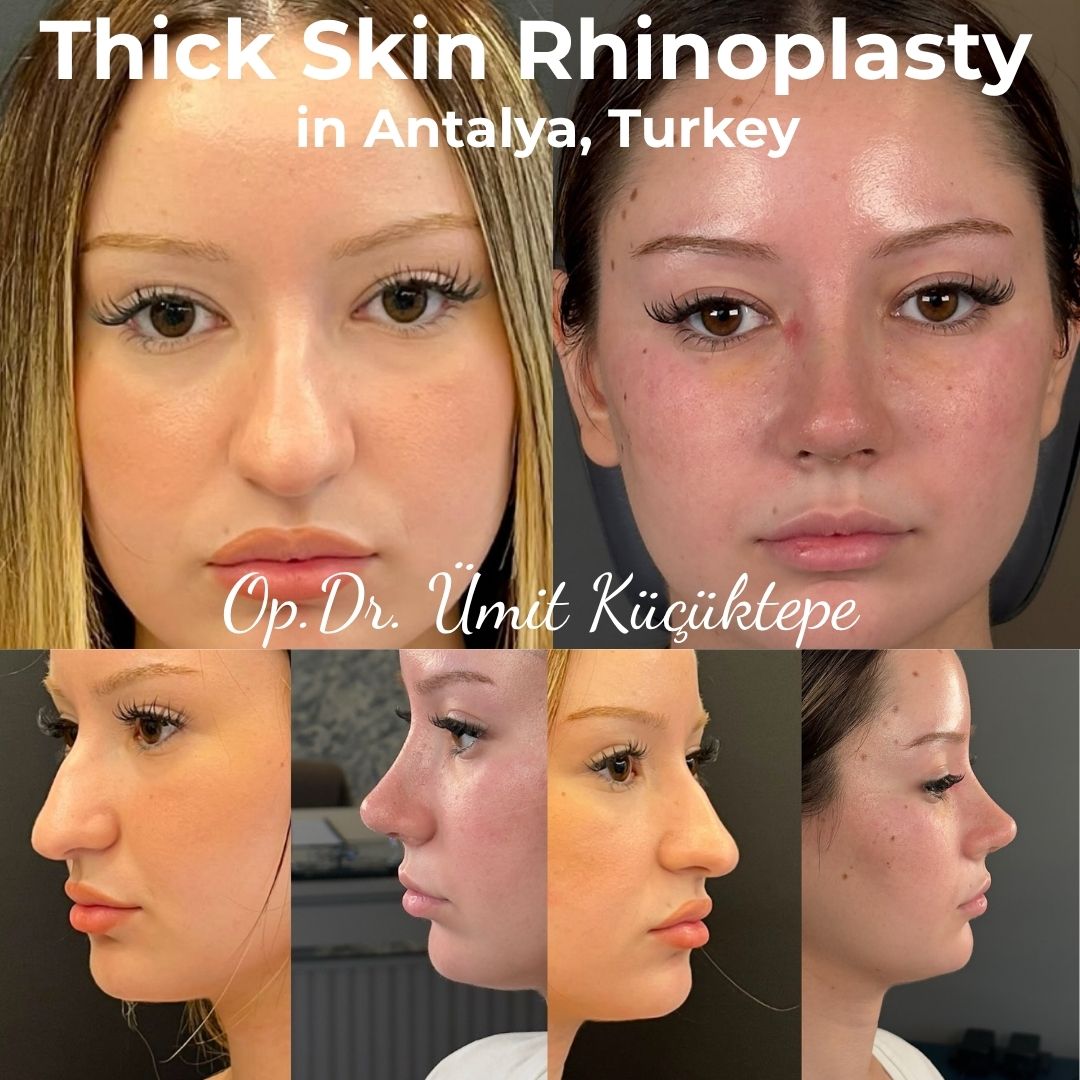
Skin thickness is one of the factors that influence rhinoplasty planning and results. It is largely determined by individual anatomy and affects how clearly the underlying cartilage contours are visible, how swelling resolves and when the final shape becomes apparent. This guide explains how surgeons assess and manage thick nasal skin, what to expect during recovery, and what to consider when planning treatment in Antalya, Turkey.
What Is Thick Skin Rhinoplasty?
There is no separate surgical technique called "thick skin rhinoplasty". The term refers to rhinoplasty performed on a nose whose skin-soft tissue envelope (the skin, fat and fibrous layer over the cartilage and bone) is denser and heavier than average. The surgical goals remain the same: reshaping the nose, improving proportion and addressing airflow issues. What changes is the surgical strategy, because thick skin behaves differently once it is draped over a reshaped framework.
What Makes a Nose "Thick-Skinned"?
Skin thickness is largely inherited and is more common in some populations, including Middle Eastern, Mediterranean, South Asian, and some African and Latin American nose types, although it can occur in anyone. Thick nasal skin usually contains more oil glands, more subcutaneous fat and a denser fibrous layer than thin skin, which gives it more weight and less elasticity.
How Can You Tell If You Have Thick Nasal Skin?
Features that may suggest thicker nasal skin include:
- The tip looks soft and rounded rather than sharply shaped, even when there is no swelling
- Visibly larger pores, especially toward the tip
- An oilier T-zone
- Pinching the tip does not reveal much of the underlying cartilage shape
- The nose looks heavier or bulkier than its bone and cartilage structure alone would suggest
These features may suggest thicker nasal skin, but they cannot confirm skin thickness on their own. During a consultation, the surgeon examines the skin, underlying soft tissue and cartilage to assess thickness, mobility and support.
How Does Thick Skin Affect Rhinoplasty?
Thick Skin and Nasal Tip Definition
A thicker skin and soft-tissue envelope can soften the appearance of the underlying cartilage contours, making fine changes at the nasal tip less visible, particularly while postoperative swelling remains. The degree of definition depends on skin thickness, tissue elasticity and the support provided by the cartilage framework.
Is Rhinoplasty More Difficult for Thick-Skinned Noses?
Thick skin can make contour refinement more demanding and may require additional cartilage support. Surgical risks and the likelihood of achieving the desired definition depend on the individual's anatomy, health, previous surgery and proposed techniques. An experienced surgeon should explain these factors and the limitations of treatment during the consultation.
Thick Skin vs Thin Skin Rhinoplasty: What Is the Difference?
Differences in Surgical Planning
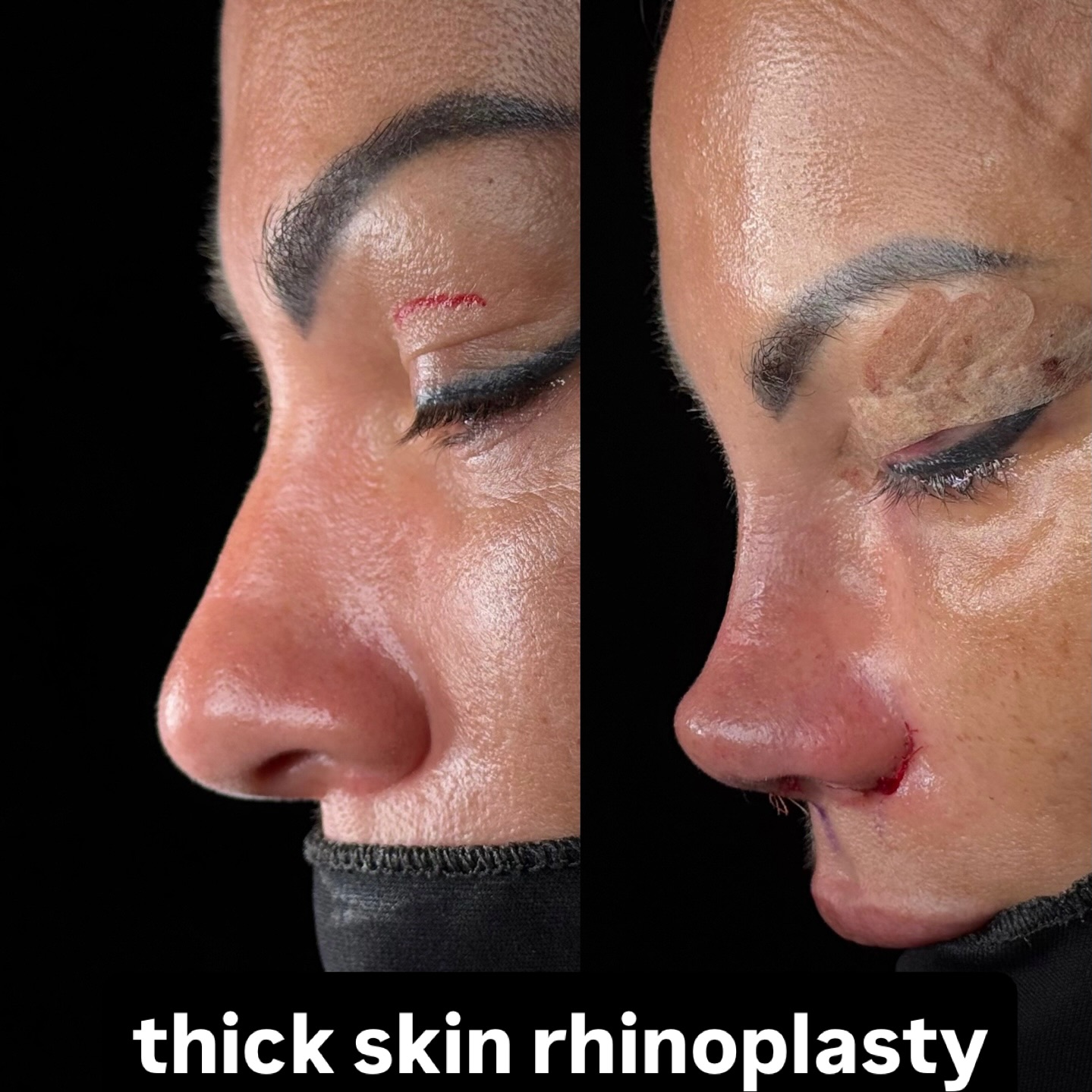
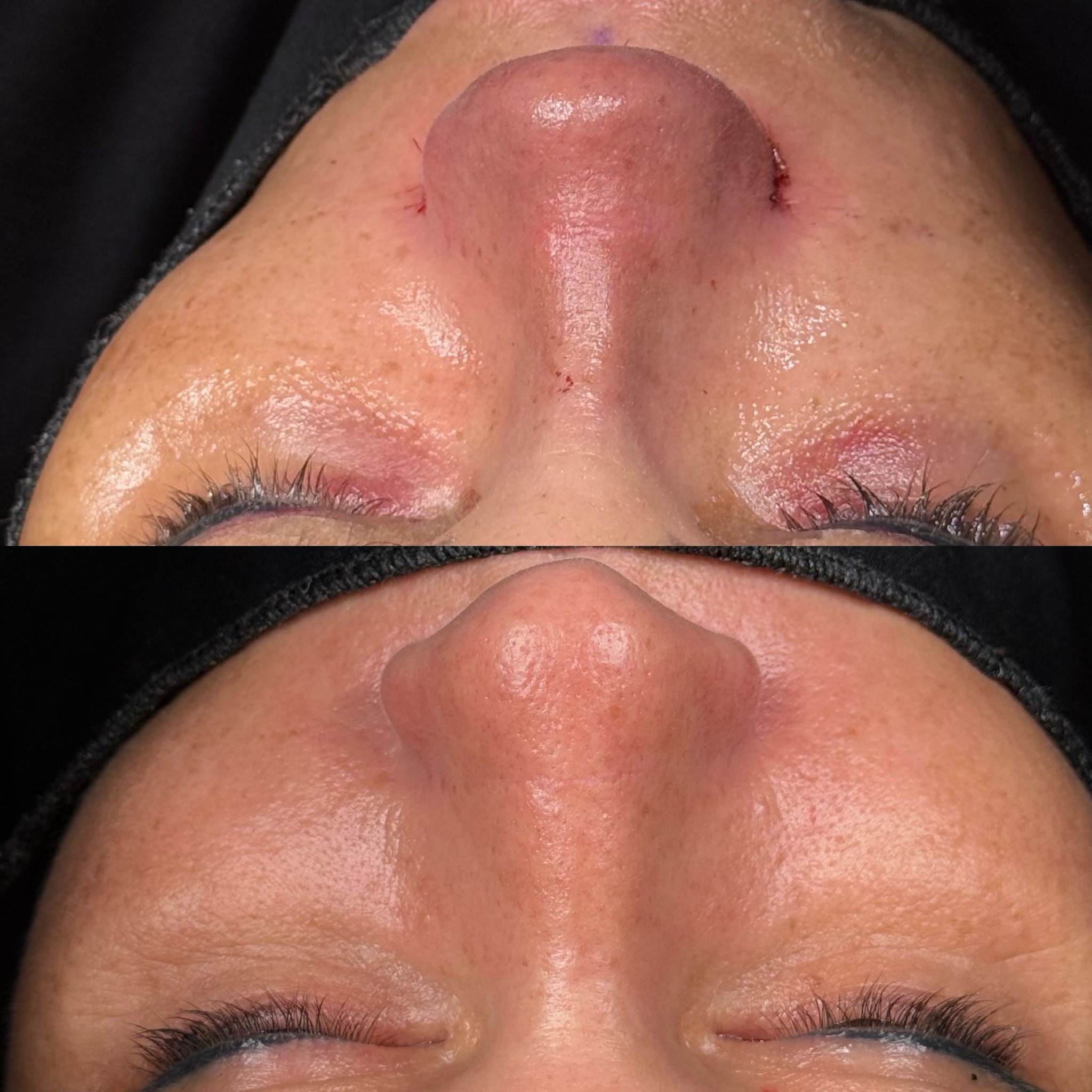
With thin skin, surgeons tend to be conservative, because small cartilage irregularities can show through the surface. With thick skin, the challenge is often the opposite: additional structural support may be needed for any definition to be visible through the tissue. The appropriate approach depends on the individual's anatomy and treatment goals.
Differences in Swelling and Recovery
Thicker nasal tissue generally means more persistent swelling after surgery. Patients with thinner skin often see their nasal contour settle in sooner, while thick-skinned noses can take considerably longer to reveal their final shape.
Differences in Final Results
Thin skin tends to produce crisp, well-defined results relatively early. Thick skin usually settles into softer, smoother contours rather than a sharply sculpted shape. This is not a worse result, only a different one, and it is best planned for from the outset.
| Feature | Thick nasal skin | Thin nasal skin |
|---|---|---|
| Tip definition | Fine cartilage detail often less visible | Cartilage contours show through more clearly |
| Swelling | Tends to persist longer | Often resolves sooner |
| Surgical planning | Adequate structural support matters most | Avoiding visible irregularities matters most |
| Final appearance | Softer contours | Finer contours tend to be more apparent |
How Is Thick Skin Rhinoplasty Performed?
Reshaping and Supporting the Nasal Cartilage
The surgeon reshapes and supports the cartilage framework so that it provides adequate projection and definition beneath the skin. The amount of support needed depends on the existing anatomy and the patient's goals.
Cartilage Grafts and Structural Support
Grafts, usually taken from the septum, the ear or, occasionally, a rib, are often used to reinforce the tip and bridge and add projection that compensates for the skin's thickness. Not every patient needs grafting; it depends on individual anatomy and treatment goals.
Creating Better Nasal Tip Definition
Some surgeons also use defatting, which is the careful thinning of soft tissue just under the skin to reduce bulk over the cartilage. It must be done conservatively, because excessive tissue removal can compromise blood supply and delay healing, so it does not suit every patient.
Who Is a Good Candidate for Thick Skin Rhinoplasty?
The general eligibility criteria are similar to those for rhinoplasty overall. Good candidates are generally people who:
- Are in good general health and have realistic expectations going in
- Understand results take longer to fully show
- Seek improved proportion and a more refined look rather than an extremely sharp, "chiselled" tip
- Have stopped growing (typically 18+) and do not have uncontrolled conditions that would affect healing
Thick Skin Rhinoplasty Recovery: What to Expect
The First Week After Rhinoplasty
Swelling is expected in the first week for everyone, but patients with thick nasal skin may experience more persistent swelling, particularly around the tip. The extent of early bruising varies between individuals. An external splint is applied, and internal splints or packing may be used depending on the technique. Most people spend this week resting at home and following the surgeon's recovery guidance. The external splint typically comes off around day seven.
Weeks 2–4: Early Healing and Swelling
Bruising usually clears faster than swelling. The nose often still looks puffy during this stage, especially at the tip, and it is not unusual for the shape to look slightly different from week to week as swelling shifts.
Months 1–3: Changes in Nasal Shape
The nasal contour gradually becomes clearer, although residual swelling may still affect the tip. The appearance at this stage should not be treated as the final result.
Months 3–6: Continued Refinement
As swelling continues to improve, changes in the nasal contour may become easier to assess. Tip definition can remain limited by residual swelling, so follow-up appointments help your surgeon evaluate progress.
Months 6–12: Gradual Tip Definition
Most patients see substantial improvement during this stage of recovery. That said, for some thick-skinned patients, subtle changes in tip definition can keep going for 18–24 months. Recovery timelines vary depending on individual anatomy and the surgical techniques used.
Managing Swelling After Thick Skin Rhinoplasty
The thicker soft-tissue envelope can make postoperative swelling more persistent, particularly around the tip. Follow your surgeon's instructions on head elevation, activity and follow-up appointments. Steroid injections may be considered for selected patients, but require an individual assessment because they can cause adverse effects such as skin thinning or contour changes.

When Will You See the Final Results of Thick Skin Rhinoplasty?
The recovery timeline above is a general guide, not a deadline. Most patients see substantial improvement between 6 and 12 months, while subtle changes in tip definition can continue for 18–24 months in some thick-skinned patients. Your surgeon will assess changes in swelling, scar tissue and tip definition at follow-up appointments. Compare progress over months rather than day to day; our guide to changes in nasal size after rhinoplasty provides further context.
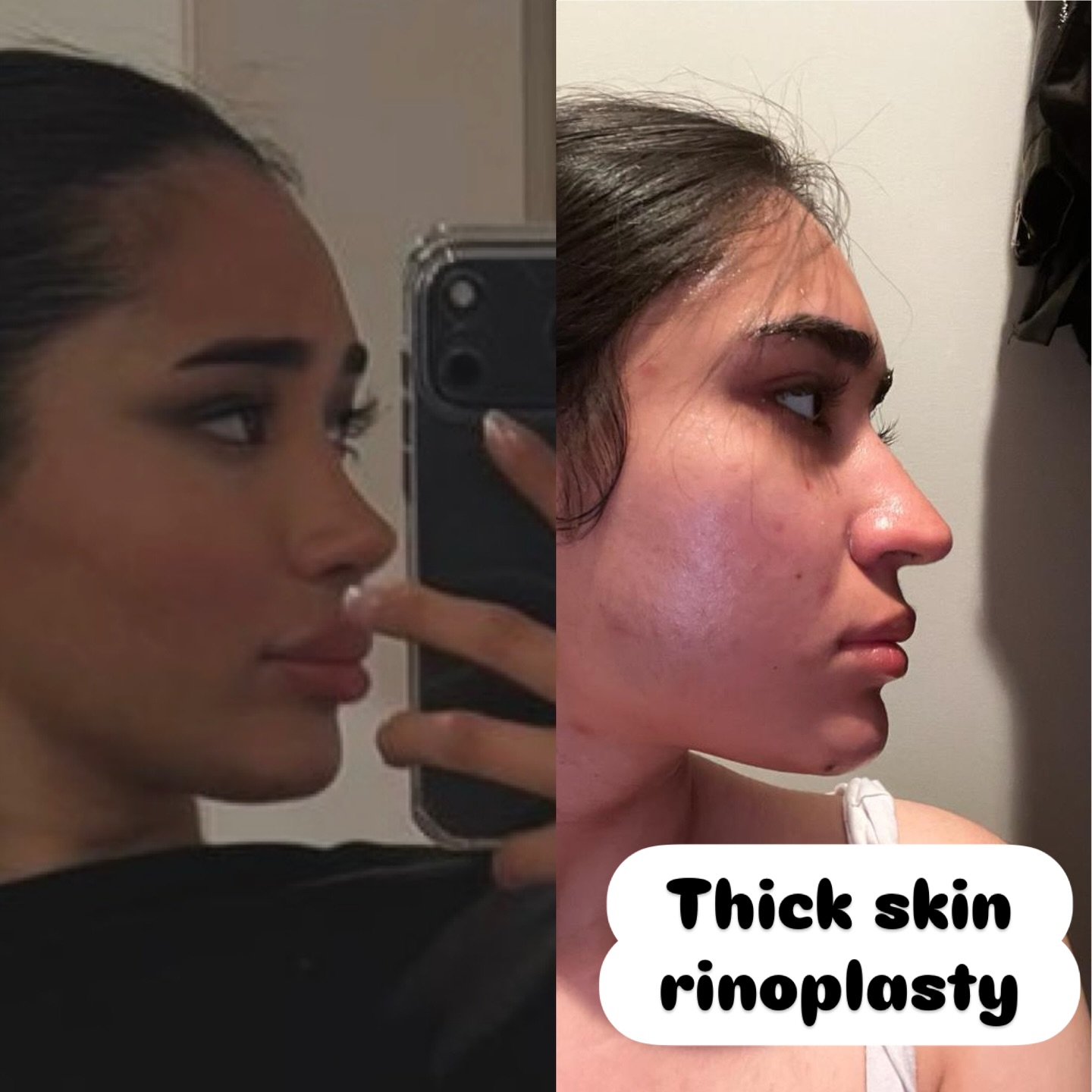
What Results Can You Expect from Thick Skin Rhinoplasty?
Can a Bulbous Nasal Tip Be Made More Defined?
Yes, although the degree of definition tends to be more moderate than with thin skin. A reduction in bulbous appearance and better overall proportion are realistic goals.
Can Thick Skin Be Made Thinner with Rhinoplasty?
Rhinoplasty primarily changes the underlying framework; it does not reliably convert thick skin into thin skin. Conservative soft-tissue reduction may reduce bulk in selected areas, but its effect on nasal tip skin thickness is variable. Any potential benefit must be weighed against risks to blood supply, healing and contour.
What Are Realistic Expectations for Tip Definition?
Improved proportion and tip definition may be achievable, but a very sharply sculpted tip may not suit the available skin and cartilage. The outcome depends on the soft-tissue envelope, underlying support, surgical technique and healing. Discuss examples involving similar anatomy with your surgeon to establish realistic goals.
Thick Skin Rhinoplasty in Antalya, Turkey
Why Do International Patients Choose Turkey for Rhinoplasty?
Patients considering treatment in Turkey may look at the surgeon's experience, access to care and arrangements for travel and follow-up. Services differ between clinics, so confirm what is included in your treatment plan. See our overview of rhinoplasty in Antalya for further information.
In Antalya, Op. Dr. Ümit Küçüktepe, an ENT and Head & Neck Surgery specialist, evaluates skin thickness, cartilage support and the internal airway during the consultation before discussing a surgical plan for thick-skinned noses.
How to Choose a Rhinoplasty Surgeon in Turkey
Check the surgeon's qualifications and the facility's licensing, and ask specifically about experience with thick-skinned noses and how your anatomy might shape the surgical plan. Questions worth bringing to the consultation:
- How much experience do you have with thick-skinned rhinoplasty specifically?
- Will my nose need cartilage grafting or extra structural support?
- What degree of tip definition is realistic for my anatomy?
- Roughly how long might swelling and recovery take in my case?
- What does follow-up look like once I am back home?
Our guide to preparing for rhinoplasty in Turkey explains further practical considerations before travelling.
How Long Should You Stay in Turkey After Thick Skin Rhinoplasty?
The length of your stay should follow your surgeon's postoperative schedule. A stay of roughly 7–10 days is typical, allowing time for early follow-up and splint removal. Fitness to fly must be confirmed directly by your surgeon. Some patients need to stay longer depending on the surgery and early healing.
Follow-Up Care After Returning Home
Before travelling, agree on a follow-up schedule and confirm how to contact the clinic after returning home. Photographs and video consultations may help monitor progress, but they cannot replace an examination when one is needed. Clarify how in-person assessment and treatment will be arranged if concerns or complications arise.
How Much Does Thick Skin Rhinoplasty Cost in Turkey?
The cost depends on the complexity of the procedure, whether it is primary or revision surgery, the need for cartilage grafting, and the hospital, anaesthesia and follow-up services included. Read more about factors affecting rhinoplasty cost, or contact our clinic for a personalised quote following an assessment of your anatomy and treatment goals.
When Should You Contact Your Surgeon After Rhinoplasty?
Some swelling, bruising and nasal congestion are normal in early recovery. However, the following should be reported to your surgeon rather than waited out:
- Pain that worsens rather than improving with medication
- Fever, or redness around the surgical site that is spreading
- Heavy bleeding, or bleeding that does not stop
- Increasing swelling accompanied by significant pain or other worrying symptoms
- New or worsening difficulty breathing
Severe breathing difficulty or uncontrolled bleeding requires urgent medical attention and should not be left to wait. If you are unsure whether something is part of normal healing, contact your surgeon.
Medical disclaimer: This article is for general educational purposes only and is not a substitute for a consultation with a qualified rhinoplasty surgeon, who can assess your individual anatomy and give personalised medical advice.
Frequently Asked Questions
Thick skin is an anatomical feature that affects surgical planning and the degree of definition that may be achievable. A consultation helps establish realistic expectations for your individual anatomy.
A rounded tip, visible pores and oily skin may suggest thicker nasal skin, but appearance alone cannot confirm it. A surgeon can assess the skin, soft tissue and cartilage during a physical examination.
It can be more demanding to plan, because more of the final shape often has to come from cartilage support rather than from the skin retracting on its own.
Rhinoplasty does not reliably convert thick skin into thin skin. Conservative soft-tissue reduction may reduce bulk in selected areas, but its effect on tip skin thickness varies and must be weighed against risks to blood supply and healing.
Yes. Better tip definition and improved proportion are both realistic goals, though the degree of definition tends to be more moderate than with thinner skin. The achievable result depends on individual anatomy and the surgical approach.
Most of the visible swelling tends to improve within the first 3–6 months, but some residual swelling, especially at the tip, can linger for 12–24 months in certain patients.
Substantial improvement usually shows up within 6–12 months, but subtle tip changes can keep evolving for 18–24 months in some thick-skinned patients. It ultimately depends on individual healing.
Yes, when the surgery also addresses functional issues such as a deviated septum or nasal valve problems. Thick skin on its own does not typically cause breathing problems, so a surgeon should assess both the external shape and the internal airway before recommending treatment.
Roughly 7–10 days is typical, allowing time for early follow-up and splint removal. The right duration, and whether you are fit to fly, must be confirmed by your own surgeon based on your recovery.
The cost depends on surgical complexity, whether revision surgery or cartilage grafting is needed, and the hospital, anaesthesia and follow-up services included. Please contact our clinic for a personalised quote following an individual assessment.
Please contact Op. Dr. Ümit Küçüktepe for an examination and further information.